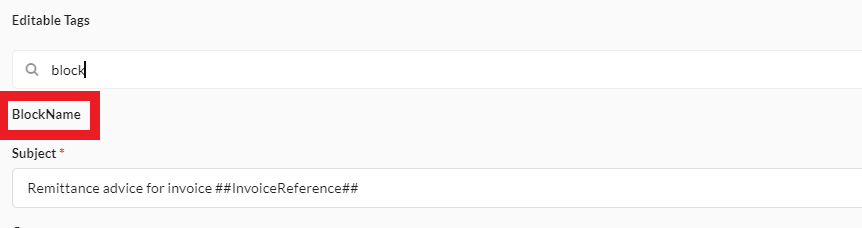
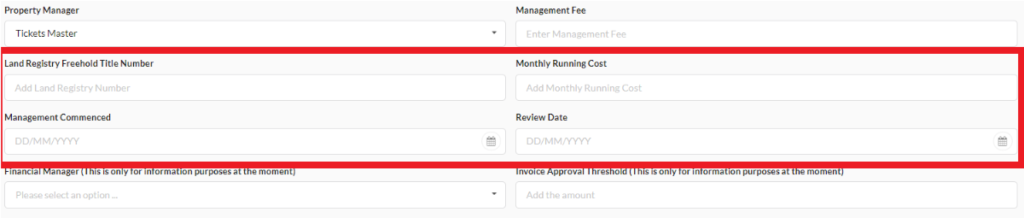
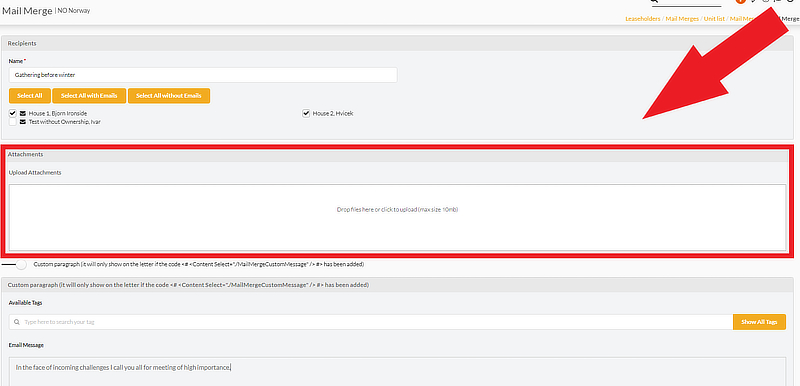
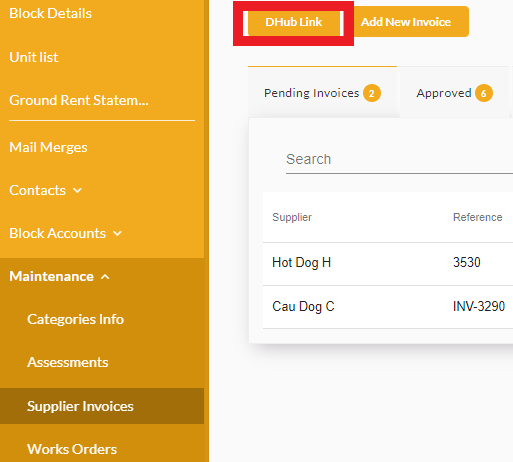
Company Report – There is a new global report which pulls details of all block Companies and their Directors
New Section in My Work – My Properties – this shows details from Blocks – Every logged Property Manager can now see their own blocks, invoices and works orders in one place
Supplier Extract – A new report accessible via More Actions on the list of Suppliers which extracts all Suppliers
Each Freeholder now has a new tab for bank details
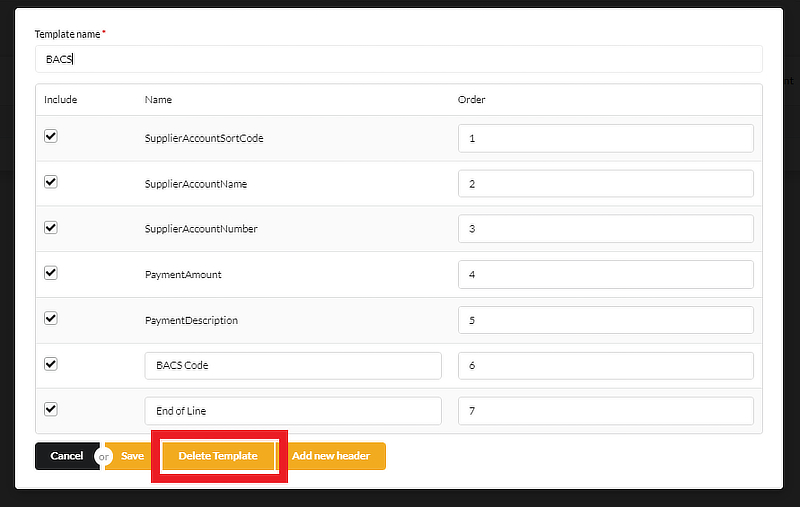
Freeholder payments are now included in BACS extracts
Download Statements from each Block for individual Freeholders – Accessible under Freeholder/More Actions
Supplier Insurance expiry date field – this can be entered for each Supplier. Adding a date creates recurring tasks. Completing the task creates another new task in 12 months time and updates the date
The ‘Send all Invoices’ automatically downloads all Invoices according to preferences in one Pdf. This also applies for automatically generated invoices. The download notification is then sent to the user who created it manually or to the Property Manager
New option for Arrears step – This can now automatically generate invoice fees for the same category as those arrears being chased. The Invoice can also be sent with the arrears letter
Breach of Lease feature – in Arrears or Ownership Details sections you now have the option to mark ‘In breach of lease’. The User is then highlighted in red, cannot be sent any messages, is not included in any mail merges and the entire arrears process sits in a new tab ‘In Breach of Lease’
UPDATES
Category specific – Leaseholder invoices with allocated credit is now locked
Freeholder payments can be accessed from the Transactions page
Tasks Extract Report – Notes extracted for each task are now in chronological order, the Column width is fixed, and the text is wrapped
New Tab on the list of Suppliers – Inactive Suppliers
We are now able to connect accounts from 105 different banks and companies in the UK! Chances are that whoever you are banking with, we can now connect you to Bank Feeds!
Supported banks:
…and many more!
The full list of supported banks can be found on Yapily’s website (please click here). For more information about Open Banking for Block Management and Resident’s Bank Feeds, please click the button below.
WE HAVE ALSO IMPROVED OUR PRICING MODEL SO IT’S CLEAR, SIMPLE, AND ATTRACTIVE TO ALL MANAGING AGENTS OUT THERE.
We really think this is an amazing feature and want everybody to be able to take advantage of it and simplify their day-to-day work. This is why we now charge just £1+VAT a month for each connected account!
Our new provider is offering enriched data, including transaction IDs for most banks. This should bring any missing transactions to an absolute minimum.
We are hoping the future will include Open Banking-powered payments, enabling users to make payments and transfers safely. Open banking payments are account-to-account, with no middlemen or unnecessary transaction fees.
Keep an eye out for further updates on this subject.
YOU MIGHT ALSO LIKE…
ORDER DHUB
DHub Supplier Invoice Upload will evolve with more features so there is no better time to pre-order.
Priced at £140 plus VAT per month (charged annually) plus £50 plus VAT for every 1000 pages of invoices processed. You can buy pages via a pay-as-you-go model. Pre-order today to get early app access.
Naturally our first integration is with Resident Block management software but future integrations are in the pipeline with the well known business book-keeping softwares and we are already receiving requests from clients to integrate with their lettings softwares. It is going to be a busy year for the Data Hub.
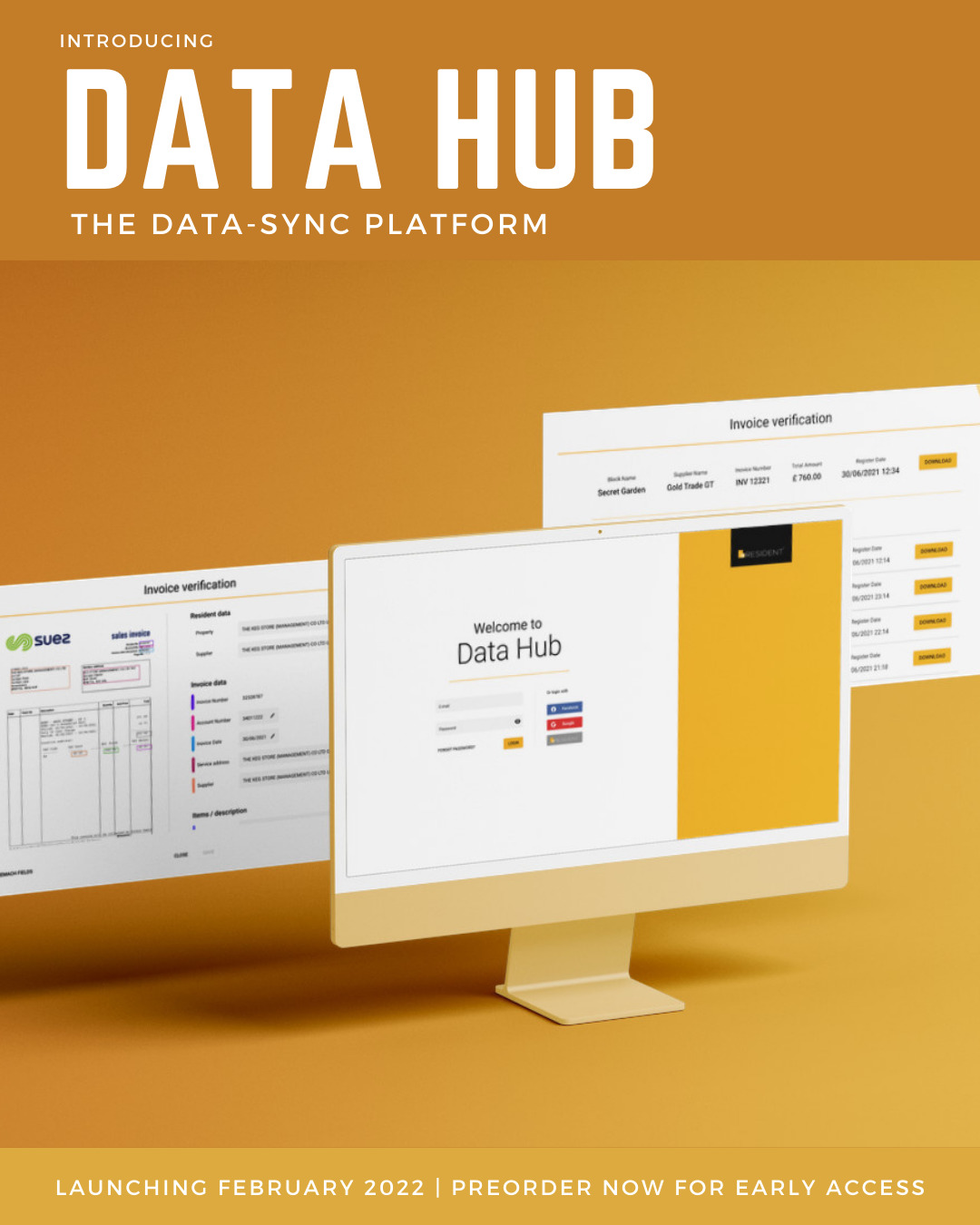
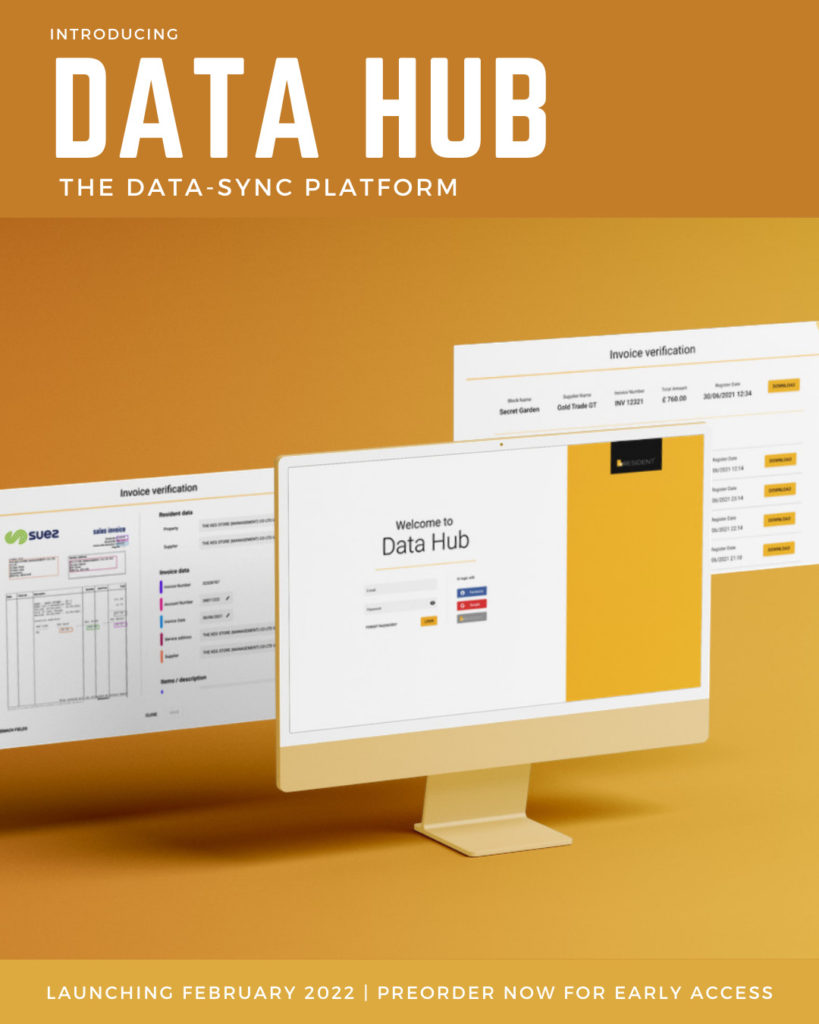
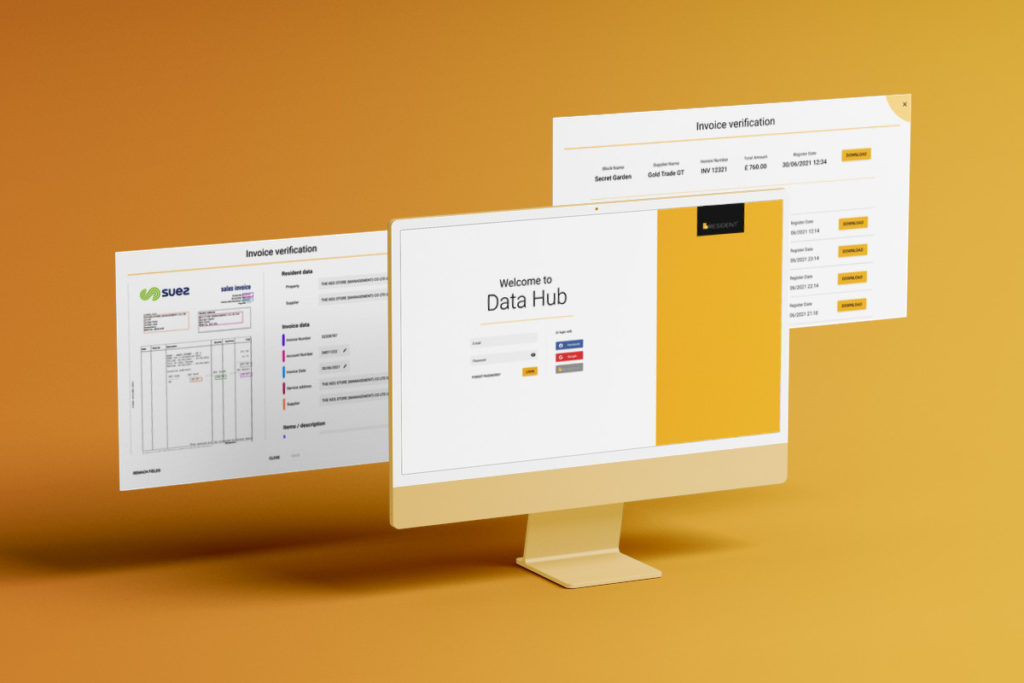
The concept was to save the time it takes to receive and process the thousands of contractors invoices block managers receive each year. The invoices are now emailed to a designated email address which enters the Data Hub. The Dhub ‘reads’ the invoice and automatically enters the relevant data into the relevant fields in Resident – including the Block, service charge schedule, expense category and allocates against any relevant works order. The hub even automatically loads a copy of the actual invoice – a feature that other similar softwares dont offer. Property Managers log into a page of loaded invoices and can approve them for payment.
Lovely feedback received from one of the first users: ‘Thanks for getting that to me, great work! I’ve just thrown in a load of invoices and showed it to the team in the office and they’re delighted, as am I. It’s the best thing Resident have done since we’ve been with you. Congratulations.’
To be honest I’m super overwhelming proud of what our independent software house has achieved with this. Credit as always to Michał Marek who makes ideas happen.
by Kate Boyes MRICS (Originally given at the ARMA Northern Chapter in January 2019, updated for this article February 2022)
I’m Kate Boyes
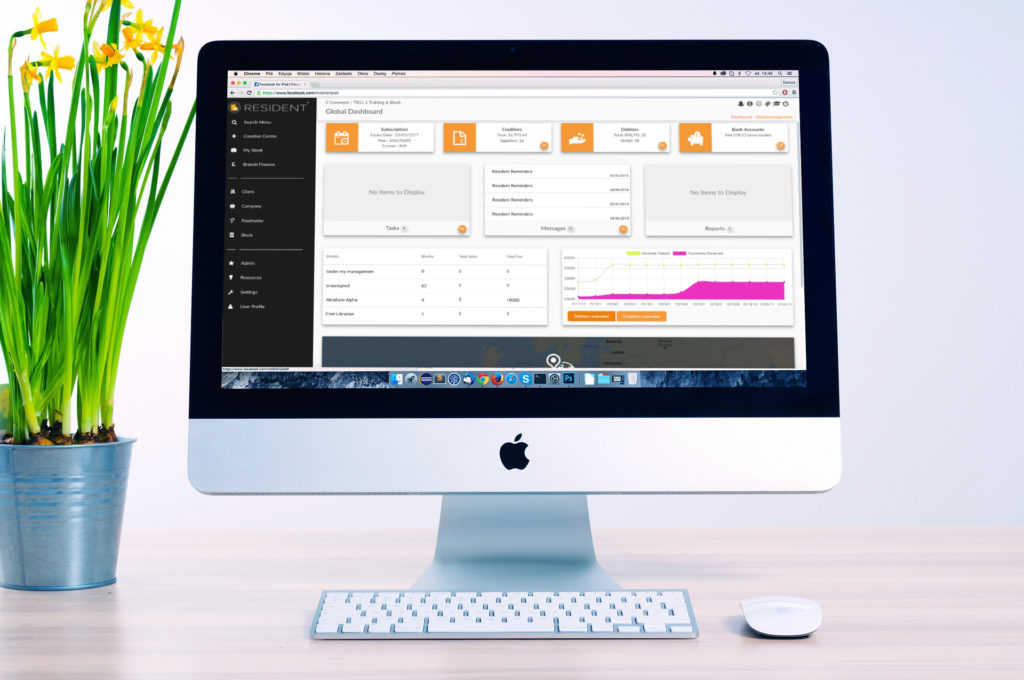
Eight years ago I founded Resident – property software developed bespokely for the block management industry.
I am a Chartered Surveyor, I have a 1st class degree in land management from the University of Reading and have sat on the board of ARLA.
I worked for a commercial landlord & tenant firm in the west end before establishing my own lettings business in the South East, and then my own block management business. Suffice to say my background is 100% property and not technology.
Resident was born from a genuine frustration with archaic and inflexible solutions to the challenges I faced everyday.
Looking back…
Go back to 2012 / 2013 – I looked after a niche estate. It was just under 100 units so not huge but certainly not small. It had about 15 service charge schedules and some distinguished features:
It was a heritage building mixed with new builds,
It had been signed off wrongly by the local council,
It needed £100k of fire upgrades; the grounds were supposed to open to the public once a year, parts of the grounds included a listed arboretum and a rockery – as you do!
AND to top it off the new builds had multi million pound NHBC claims.
Where do you start with communicating this with the residents?! Where do you start with that level of financial reporting?!
The workload
I would prepare bespoke financial reports for the directors once a month. I asked the software package I used at the time to build a template for me. They couldn’t. I was a property manager, not fluent in code, and I simply didn’t understand the complexities of prepayments and accruals. The software I used just didn’t understand the plight of a property management department and I didn’t understand the software I used either!
I needed to email updates to the client daily. But I didn’t need or want to see the round robin debates from the leaseholders.
I needed answers to decisions but I didn’t need to know that they would let me know their decision after their lunch, where they were eating, what they were eating and who with!
I am being flippant but you know exactly what I mean.
Resident
So to cut a long story short I took my 84 point checklist of things property managers need to do with each block; yes, my 84 point checklist.
I worked out that my accountant was handling company secretary stuff over here, my spreadsheet was handling reminders over there, my software was generating service charge demands and payments but I didn’t really understand the software and the clients didn’t begin to understand the system standard generated reports.
I had a a server in the office storing documents over here, a million emails over there, and would spend hours printing and posting service charge demands. So I set about building ONE platform for everything – the first version of Resident was born in 2015.
Technology
What i have learnt about how it can assist property managers?
#1
IT and technology companies should not shroud simplicity with complexity as a way of increasing their charges – this happens a lot.
#2
There are ’cloud based systems’ that aren’t true cloud systems. These still rely on networks and therefore overheads in IT costs
Agents need to start by looking at their internal infrastructure:
#1
Servers, networks, email hosting, telephone hosting – there are such simple solutions that cost absolutely nothing and offer flexible agile working compared to the IT contracts and leases I was tied into and I still see so many tied into.
#2
Expectations are moving so fast – a year ago clients queried our cloud based product as wanted security of their in-house servers; now clients want to get Resident working as perfectly as possible as quickly as possible because they too want to reduce their overheads – office space, travel, flexi working etc.
BUT technology is not about creating solutions for problems that don’t really exist.
In your day to day role:
What can be automated?
What is a waste of a persons time?
What are the jobs that feel so tedious because you feel like you are wasting your time doing them, but need to be done?
What do clients want?
Thats where technology steps in.
Clients
Clients want you. They want to see you, to talk to you, to discuss. To debate. To listen. To hear. To see that you care and that you are present.
A computer will never, in my opinion, replace this.
And to be honest do we really want it to? I don’t think any of us entered the property industry because we wanted to sit behind a desk. In fact isn’t that the answer all of us gave to our first job interview in this industry? Why do you want to work in property?
Clients want transparency on the information they can access:
how much is in the bank?
who hasn’t paid their service charges?
was this supplier paid?
was this invoice posted on the correct schedule?
The client doesn’t care that it took you 40 hours this week to post this on the system. They just want to see the results. And what’s the point in a system that they can log in to see if the information they see is a month out of date? They will still call you; you will still spend time looking it up.
The strategy
There is a perhaps well known insight on LinkedIn from a JP Morgan director on customer focused strategy:
NETFLIX did not kill Blockbuster, ridiculous late fees did.
UBER did not kill the taxi business, limited taxi access and fare control did.
APPLE did not kill the music industry, being forced to buy full-length albums did.
AMAZON did not kill other retailers, bad customer service did.
AIRBNB isn’t killing the hotel industry, limited availability and pricing options are.
And I suppose this is the point I am getting to:
Technology by itself is not the real disruptor. Not being customer-centric is the biggest threat to any business.
So what do I foresee as some cracking technologies that will assist you in the years to come?
Fintech
Companies such as GoCardless & Stripe
For example, a leaseholder receives their service charge demand which has a simple web link or button to click. They click and a pre-formatted form pops up whereby they enter their bank details and you have already set it behind the scenes to take a one off lump sum, or monthly payments and hey presto.This information is reported back to your software. Job done.
Open Banking
This is the secure way to give providers access to your financial information.
Directly feeds bank transactions from individual bank accounts not an easy task
It will enable financial controllers / book-keepers to provide live bank account information to their clients. The better the quality of the information the happier agents will be in offering this transparency. It will also enable them to spend the time to sit and discuss the financial results with the clients; rather than spending time data inputting which should be automated by tech.
Estimated to save around 80% of book-keeping time, and will also evolve into flexible online payments and receipts direct from the banks no doubt replacing direct debits and standing orders.
OCR technology
Enabling suppliers invoices to be scanned in bulk, the details read by the system, and auto loaded into the system with a copy of the invoice attached – statistics on the time saving is hard to predict but it’s huge and i anticipate one to three days per week for the average book-keeper in this industry.
Data Webhooks / APIs
The ability for all changes within the system to be sent to a financial spreadsheet that directors can access at any time and can even be templated for specific clients if needed. It doesn’t even need to be financial this could relate to works orders and tasks.
Technology by itself is not the real disruptor. Not being customer-centric is the biggest threat to any business.
Marketing
AdminTech
Thinking about directors meetings & AGMs. Not only the time taken holding the meeting but typing up the minutes and action points afterwards. Digital devices that enable pen-to-paper note-taking and conversion to text – such as the Remarkable products are already providing time saving solutions to these challenges.
Other
Inspection apps & works orders – automated and repopulated
Risk Assessments
End of Year Packs (automated)
Pre Sales Packs (automated)
Insurance renewals (automated)
Smart meters – taking longer than anticipated to roll out. However the ability to report these back to your software and supplier lifts yet more un-necessary work. Let someone else deal with the renewals, unit prices, contracts by using a utility management company.
Live chat – for me this has worked really well for utility accounts where I don’t want to pick up a phone and the associated wait time, and cannot remember my log in details or never wanted to register in the first place. I think there is a lot of consideration to be given to this as a resource for managing agents.
Artificial intelligence – I will be honest, I still don’t really understand this especially in our marketplace. BUT from what I do understand there is a market for using a knowledge base for the computer to answer questions such as where is the water meter; when are the bins collected?
But with a change of agent, will all this information be lost as who owns this knowledge base?
This brings me to my final point:
It’s all about data
Technically the clients file is officially their file. If they request it; it is theirs.
So the data you are administering online as managing agents is your clients data.
Don’t we therefore have a responsibility to make sure it is stored in a standardised way? Flights, insurance and accommodation all have standardised data sharing. But not property. And yet we are in charge of individuals greatest assets. It’s quite bizarre if you think about.
I can log into Clear Score and see my credit history for the past 6 years and what credit card payments I made to whom and when. Why in theory can I not do this with my service charge?
And why as an agent is it so hard to access historical information when a block has quite naturally been managed by multiple agents over the years with maybe a smidgeon of self management in between.
The bigger agents have departments just for exiting clients. That’s mad. The clients should have instant access to their data. But for this there needs to be Data Standards. Softwares need to adhere to a set of Data Standards written by our professional bodies in practice statements and guidance notes. Unfortunately this still seems a long way off. I am proud to say that since making this talk in 2019 Resident has been successfully offering Open Banking to its Clients and in February 2022 (this month) we are launching our own OCR technology called the Data Hub for processing supplier invoices – read more on this new software here – https://dhub.uk.com/
We are too excited to hold back any longer, so here’s another sneak peek of our fantastic DHub software going live in February.
This time we take a quick look at the text recognition mechanism and how it will work in DHub. Watch and let us know what you think! We hope you share our excitement.
WANT TO KNOW MORE?
Please keep an eye out for further exciting DHub news to follow.
PREORDER NOW AND GET EARLY ACCESS
DHub Supplier Invoice Upload will evolve with more features so there is no better time to pre-order.
Priced at £140 plus VAT per month (charged annually) plus £50 plus VAT for each 1000 pages of invoices processed. You can buy pages via a pay-as-you-go model. Pre-order today to get early app access.
New versions of LPE1, LPE2 and FME1 forms launching in January 2022.
A number of trade and representative bodies representing the legal, surveying, estate agency and property management sectors launched updated versions of the LPE1 (Leasehold Property Enquiries), LPE2 (Consumer summary) and FME1 (Freehold Management Enquiries) forms. The forms will “go live” on 11th January 2022.
IRPM alongside, bodies such as the Law Society, Conveyancing Association, CILEX, Society of Licenced Conveyancers as well as ARMA, ARHM, BPF, RTMF and ARLA are encouraging member firms and members to use the new versions from 11th January 2022.
The updated forms now include the UPRN of the property with the updated form fields included within the pdfs. These versions of the forms ask administrators whether they can accept service of notice by email and receive the payments via the banking system to enable more efficiency in the process.
This is the third version of the LPE1 form with a number of new additional questions and amendments made.
It establishes whether there are any restrictions on keeping pets or parking. The form also asks whether a fire safety or an external fire wall assessment has been undertaken, and whether there are urgent works required as a result. It is hoped this will allow those marketing the property to identify material facts around cladding more easily. A portal to access external wall system reviews has been created by the Fire Institute Association; the Building Safety Portal.
The Freehold Management Enquiries (FME1) form is on its second version and contains a number of additional questions including who deals with the deed of covenant, on contributions to the service charge, and access to insurance.
The forms can be downloaded for free from the IRPM website here, and are also available via the law firm stationers so that any systems using the forms or pre-populating the forms can be updated by 11th January 2022.
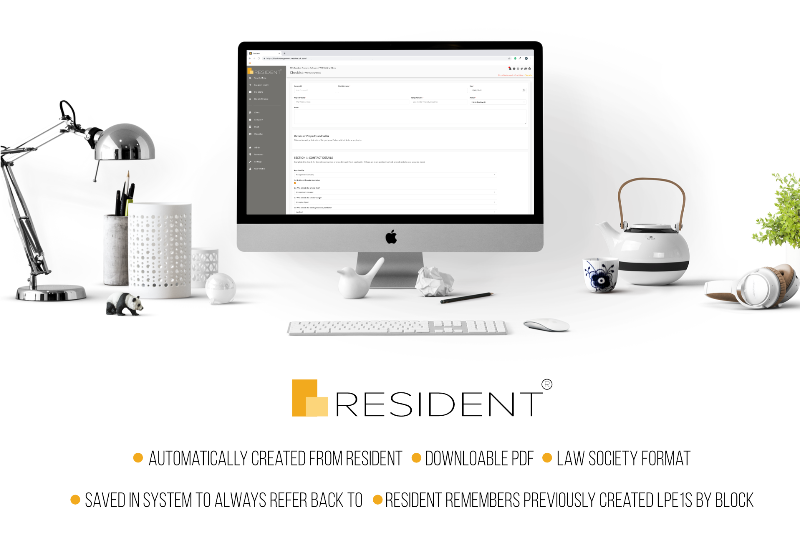
We’ve got you covered Resident will be automatically updating the forms within the system in time for 11th January, including a new field on each unit for UPRNs so these autofill when you use our pre-sales function.
IRPM CEO, Andrew Bulmer, mentions: “It must be at least ten years ago that the legendary Gerry Fox and I pushed for a common format for replies to enquiries. Other stakeholders thought the same and a sector-wide initiative delivered the first LPE1. The subsequent and comprehensive adoption of this ‘blindingly obvious’ document is testimony to the power of collaboration when stakeholders come together for good. I am delighted to see the latest edition upholding that principle.”
Beth Rudolf, Director of Delivery at the Conveyancing Association, commented: “The industry has committed to ensuring the forms are up to date and continually assessed to make sure they ask for all the necessary information. These new iterations of the forms do just that, and particularly in light of the ongoing issues many leaseholders are having with their building’s fire safety, it is clearly very important that all stakeholders have full upfront and transparent information on this aspect of the property. We’ll continue to review these forms to make sure they are fit for purpose going forward and in particular as their becomes greater clarity over the need for external wall assessments and access to them. ”
The following features/updates have now been deployed:
New Features
New Tile within the Leaseholder dashboard – There is a new tile which appears on the Leaseholders dashboard if you enable the section with Suppliers Invoices
Ticketing button restored – After receiving feedback about the Ticketing button being inconveniently hidden we have restored the old ticketing button in the top right corner. Now the orange question mark icon only gives you access to the knowledge base.
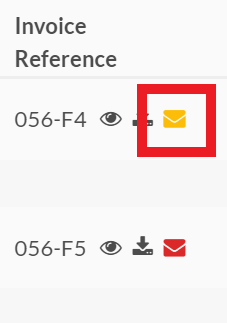
Invoice Groups – There is a new envelope colour (yellow) for those Invoices which have not been sent. It could be a case of incorrectly formatted emails.
Christmas is getting closer and during this Festive period we would like to share our excitement for this new product coming in February 2022.
This is why we’ve put together a short video presenting the general look and feel of our brand new app:
Dhub will reduce your manual work (especially with Supplier Invoice processing) with increased accuracy at the same time.
CORE FEATURES
Text recognition
Full integration with Resident (other softwares to come)
Multi-User access
Internal Notifications System
Another approval layer which picks up duplicates
Full audit trail for each invoice
PREORDER NOW AND GET EARLY ACCESS
DHub Supplier Invoice Upload will evolve with more features so there is no better time to pre-order.
Priced at £155 plus VAT per month (charged annually) plus £50 plus VAT for each 1000 pages of invoices processed. You can buy pages via a pay-as-you-go model. Pre-order today to get early app access.
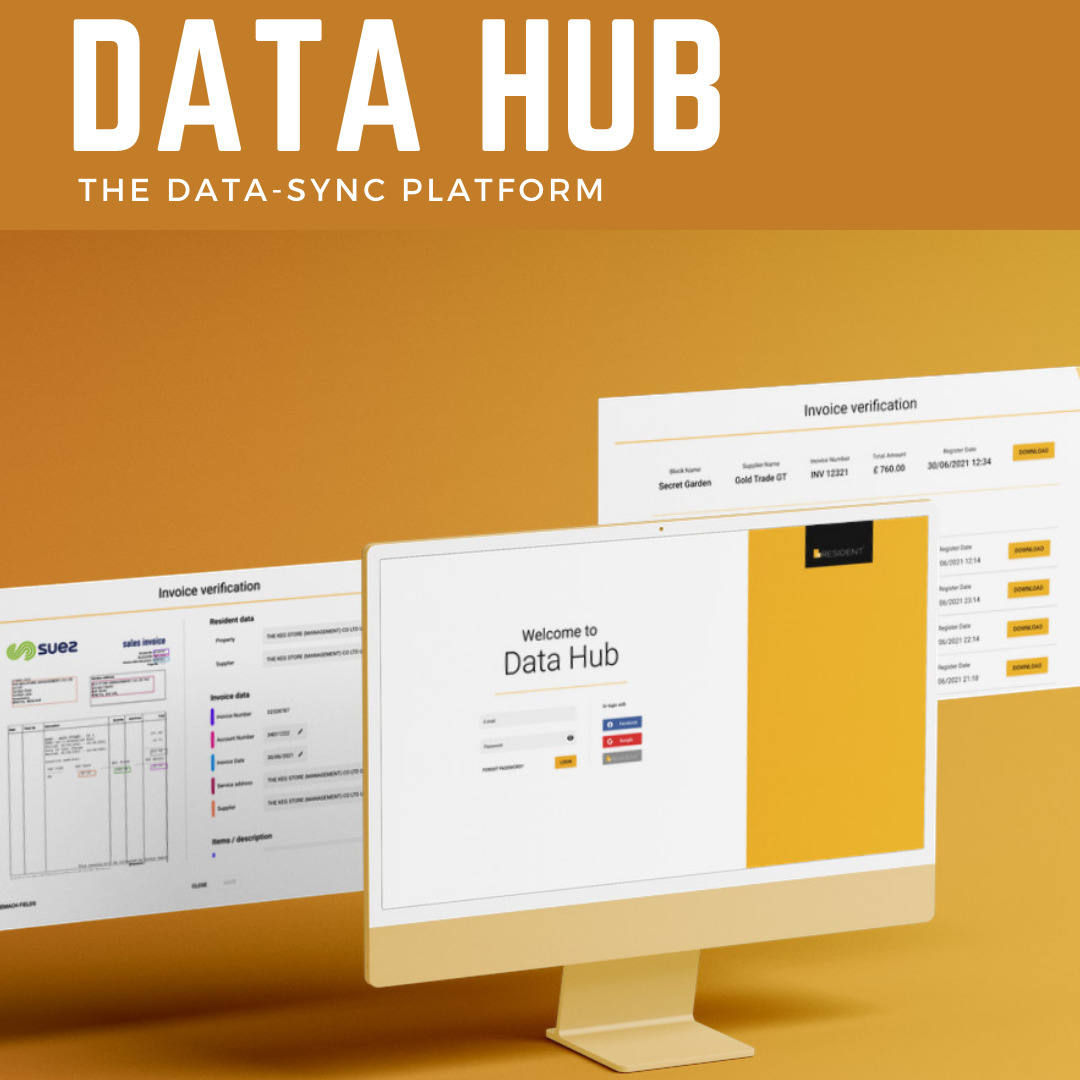
Dhub is the new platform designed to integrate with various systems and pull their data. One platform to manage all the different types of data your company works with.
Technology is the enabler, not the disruptor
In 2019 I spoke at the ARMA Northern Regional Chapter in Manchester on technology in the block management industry. The subject was ‘Technology is the enabler, not the disruptor’ – Property will always be about people – looking at the future of block management and how technology is the enabler for the block management industry to provide clients & leaseholders with more of what they want.
One of the six areas I predicted technology would most assist block managers in 2020 and beyond was something called OCR ‘Optical Character Recognition’.
DATA HUB & OCR
OCR is is a business solution for automating data extraction from printed or written text from a scanned document or image file and then converting the text into a machine-readable form to be used for data processing.
One of the core block management tasks that causes a blockage to productivity is the time taken receiving, loading, and processing supplier invoices into the payment approval process.
And so Resident has created our new Data Hub for invoice processing – estimated to save 2 to 3 days of the working week for the average service charge book-keeper. The supplier emails their invoice to the designated email address, the invoice automatically enters the Resident hub and is automatically allocated to the correct Block, Schedule and corresponding works order. Property Managers log into the hub and mark the relevant invoices as approved for payment which then progresses into BACS.
ORDER TODAY!
Priced at £155 plus VAT per month (charged annually) plus £50 plus VAT for each 1000 pages of invoices processed. You can buy pages via a pay-as-you-go model.
EPISODE #1: Electric Car Charging by KDL Law and Future Group.
In this episode, KDL Law and Future Group experts discuss how property managers can approach the installation of electric vehicle charging points on managed blocks and estates.
We use cookies on our website to give you the best and most relevant experience. By clicking “Accept All”, you consent to the use of all the cookies. However, you may visit "Cookie Settings" to provide a controlled consent. Our Privacy Policy is available here.
This website uses cookies to improve your experience while you navigate through the website. Out of these, the cookies that are categorized as necessary are stored on your browser as they are essential for the working of basic functionalities of the website. We also use third-party cookies that help us analyze and understand how you use this website. These cookies will be stored in your browser only with your consent. You also have the option to opt-out of these cookies. But opting out of some of these cookies may affect your browsing experience.
Necessary cookies are absolutely essential for the website to function properly. These cookies ensure basic functionalities and security features of the website, anonymously.
Cookie
Duration
Description
cookielawinfo-checkbox-advertisement
1 year
This cookie is used to record the user consent for the cookies in the "Advertisement" category .
cookielawinfo-checkbox-analytics
11 months
This cookie is used to store the user consent for the cookies in the category "Analytics".
cookielawinfo-checkbox-functional
11 months
This cookie is set to record the user consent for the cookies in the category "Functional".
cookielawinfo-checkbox-necessary
11 months
This cookie is used to store the user consent for the cookies in the category "Necessary".
cookielawinfo-checkbox-others
11 months
This cookie is used to store the user consent for the cookies in the category "Other".
cookielawinfo-checkbox-performance
11 months
This cookie is used to store the user consent for the cookies in the category "Performance".
PHPSESSID
session
This cookie is native to PHP applications. The cookie is used to store and identify a users' unique session ID for the purpose of managing user session on the website. The cookie is a session cookies and is deleted when all the browser windows are closed.
viewed_cookie_policy
11 months
This cookie is used to store whether or not the user has consented to the use of cookies. It does not store any personal data.
Functional cookies help to perform certain functionalities like sharing the content of the website on social media platforms, collect feedbacks, and other third-party features.
Cookie
Duration
Description
geo
session
This cookie is used for identifying the geographical location by country of the user.
Performance cookies are used to understand and analyze the key performance indexes of the website which helps in delivering a better user experience for the visitors.
Cookie
Duration
Description
swpm_session
session
This cookie is used for membership login session and to provide access to the protected content on the website.
Analytical cookies are used to understand how visitors interact with the website. These cookies help provide information on metrics the number of visitors, bounce rate, traffic source, etc.
Cookie
Duration
Description
_ga
2 years
The _ga cookie, installed by Google Analytics, calculates visitor, session and campaign data and also keeps track of site usage for the site's analytics report. The cookie stores information anonymously and assigns a randomly generated number to recognize unique visitors.
_gat_gtag_UA_81826127_4
1 minute
Set by Google to distinguish users.
_gid
1 day
Installed by Google Analytics, _gid cookie stores information on how visitors use a website, while also creating an analytics report of the website's performance. Some of the data that are collected include the number of visitors, their source, and the pages they visit anonymously.
CONSENT
2 years
YouTube sets this cookie via embedded youtube-videos and registers anonymous statistical data.
Advertisement cookies are used to provide visitors with relevant ads and marketing campaigns. These cookies track visitors across websites and collect information to provide customized ads.
Cookie
Duration
Description
VISITOR_INFO1_LIVE
5 months 27 days
A cookie set by YouTube to measure bandwidth that determines whether the user gets the new or old player interface.
YSC
session
YSC cookie is set by Youtube and is used to track the views of embedded videos on Youtube pages.
yt-remote-connected-devices
never
YouTube sets this cookie to store the video preferences of the user using embedded YouTube video.
yt-remote-device-id
never
YouTube sets this cookie to store the video preferences of the user using embedded YouTube video.